The manual search for supercar components is an obsolete methodology that compromises mechanical integrity and project timelines. High-performance maintenance requires more than fragmented marketplace browsing; it demands a centralized exotic car parts database capable of cross-referencing global inventories in real-time. You've likely experienced the friction of inconsistent part number formatting across regions and the persistent risk of counterfeit components. These inefficiencies don't just waste hours. They introduce critical vulnerabilities into the supply chain of high-value assets where technical precision is the only acceptable standard.
This technical guide provides a comprehensive framework for utilizing structured data to locate and verify rare supercar components. You'll gain a specific methodology for navigating 300,000+ listings, verifying OEM part numbers, and conducting global price comparisons without the noise of traditional e-commerce. We analyze the shift toward data-driven procurement, the impact of June 2026 customs enforcement updates, and the specific tools required for precision sourcing in a volatile global market. Every data point serves as a functional bridge between complex global inventories and the end-user.
Key Takeaways
- Identify the architectural distinction between traditional e-commerce shops and centralized data aggregation tools for global sourcing.
- Utilize a technical exotic car parts database to verify component authenticity via manufacturer markings and assembly diagrams.
- Establish data-driven benchmarks for comparing OEM specifications against high-performance aftermarket components.
- Synchronize global inventory and logistics data programmatically through the integration of specialized APIs.
- Track and manage component listings in real-time using the mobile-optimized Inventory App.
Understanding the Architecture of an Exotic Car Parts Database
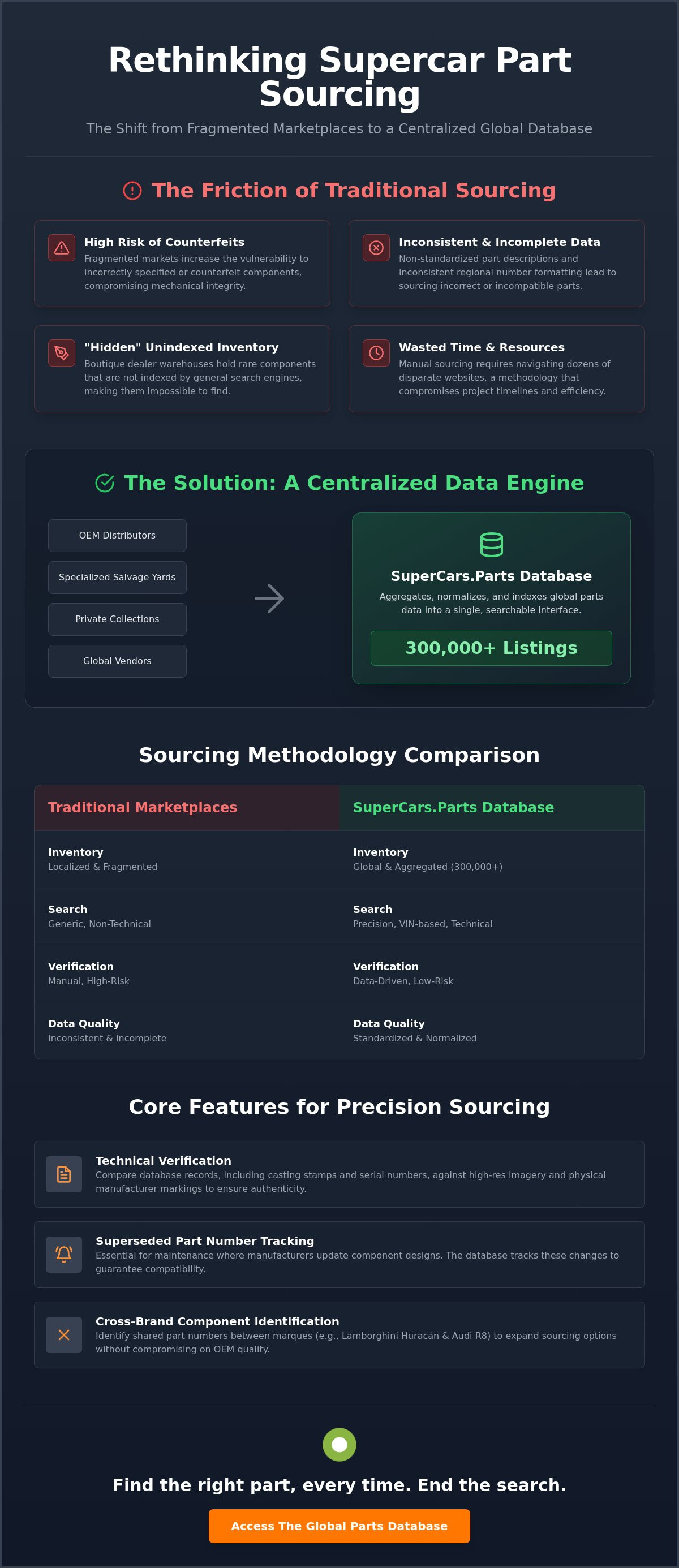
A centralized exotic car parts database functions as a technical search engine rather than a conventional retail storefront. Traditional e-commerce sites manage localized, internal inventory. In contrast, a database aggregates data from diverse global sources, organizing over 300,000 listings into a single, searchable index. This architecture relies on high-precision metadata. Brand, Model, Year, and Part Number serve as the primary keys for data retrieval. This structured approach eliminates the fragmentation typical of the exotic parts market. It connects OEM distributors, specialized salvage yards, and private collections through a unified interface.
Aggregation involves more than simple listing collection. It requires the normalization of data from vendors in different geographic regions. Regional part number variations and currency fluctuations are standardized within the database architecture. This process transforms raw, fragmented data into a functional tool for professional workshops and dealers. By centralizing these records, the database acts as a sophisticated digital librarian, providing immediate access to the global supply chain. It functions as a high-performance bridge between complex inventories and the end-user.
The Limitations of Traditional Marketplaces
Generic broad-market platforms or standard auto sites introduce significant search friction. These marketplaces lack the technical granularity required for supercar components. Part descriptions are often non-standardized or incomplete. Boutique dealer warehouses frequently hold "hidden" inventory that remains unindexed by general search engines. Manual sourcing fails when seeking rare components, such as specific internal engine assemblies for high-performance models or specialized carbon fiber trim pieces from prestigious marques. Without a specialized exotic car parts database, users must navigate dozens of disparate websites, increasing the risk of sourcing incorrect or incompatible parts.
Core Data Points for Precision Sourcing
Precision sourcing requires a hierarchy of data points. VIN-based searching and Electronic Parts Catalogs (EPC) provide the baseline for chassis-specific accuracy. A robust database tracks "superseded" part numbers. These are essential for exotic car maintenance where manufacturers frequently update component designs during a model's production run. Categorization follows a logical mechanical hierarchy: Powertrain, Chassis, Body, and Electronics. This modular arrangement allows for rapid identification of specific assemblies. Users can access the exotic car parts search engine to verify technical specifications against physical manufacturer markings. This data-first approach ensures every component matches the original factory build sheet, maintaining the vehicle's provenance and mechanical integrity.
Technical Verification: Utilizing Data to Ensure Part Authenticity
Verification isn't optional. It's a technical requirement. The risk of counterfeit or incorrectly specified components is high in fragmented markets. A comprehensive exotic car parts database mitigates this risk by providing a technical baseline. It allows for the comparison of database records against physical manufacturer markings. This includes casting stamps, laser-etched serial numbers, and specific material finishes. When data points match the physical asset, the probability of successful installation increases. High-resolution imagery within the database further confirms component orientation and condition, serving as a primary tool for remote verification.
Structured data reveals component overlap between brands. Performance engineering often utilizes shared platforms across manufacturer groups. For example, specific sensors, braking components, and electronic modules are identical between the Lamborghini Huracán and Audi R8. Identifying these shared part numbers via a technical database expands sourcing options without compromising on OEM quality. It's an efficient method for bypassing the specialized pricing often applied to identical components branded for higher-tier marques. This cross-referencing capability is a core function of a sophisticated data tool.
Interpreting Technical Diagrams and Schematics
Exploded view diagrams are essential for complex assemblies. Consider a McLaren 720S suspension. The database entry must distinguish between a complete control arm assembly and individual sub-components like bushings or ball joints. Misinterpreting orientation is a common failure point in manual sourcing. Technical diagrams clearly define Left Hand (LH) vs. Right Hand (RH) configurations. These schematics act as a visual audit trail. They ensure the component's geometry and mounting points match the vehicle's specific production year and chassis number.
The Importance of Provenance and Documentation
Documentation establishes the component's history. Databases categorize inventory into specific condition states: New Old Stock (NOS), OEM New, or Take-off. NOS parts are original factory stock that remained uninstalled, often featuring original packaging and manufacturer hologram data. Take-off parts are salvaged from low-mileage vehicles. Verification requires high-resolution imagery to inspect for surface wear or structural damage. Professional buyers use the exotic car parts search engine to validate seller claims against documented factory standards. This data-driven verification process ensures mechanical integrity and protects the vehicle's long-term value.
OEM vs. Aftermarket: A Data-Driven Comparison
Distinguishing between Original Equipment Manufacturer (OEM) components and aftermarket alternatives is a critical procurement decision. An exotic car parts database provides the objective metrics required for this evaluation. OEM parts adhere to the exact technical specifications established by the vehicle's engineering team. These components ensure structural integrity and preserve the vehicle's provenance. Sourcing OEM is often the only pathway for maintaining the resale value of limited-production assets. Conversely, high-performance aftermarket brands like Novitec or Akrapovič offer optimizations in weight, thermal management, or acoustics. The database allows users to compare these distinct categories based on availability, lead times, and technical compatibility.
Data-driven comparison eliminates the ambiguity often found in enthusiast forums. By utilizing a structured exotic car parts database, professional buyers can analyze price variance across global vendors for both OEM and third-party options. This transparency is vital when managing restoration budgets or performance builds. While OEM parts guarantee a 100% fitment rate, top-tier aftermarket manufacturers provide documented performance gains that may exceed factory benchmarks. The choice depends on the specific project goals: maintaining historical accuracy or enhancing mechanical capability. You can access the exotic car parts search engine to conduct these comparative analyses in real-time.
When to Prioritize OEM Components
Safety-critical systems require non-negotiable adherence to factory standards. Braking systems, engine internals, and supplemental restraint systems (SRS) should remain OEM to ensure predictable performance under extreme loads. For collectors seeking Ferrari "Classiche" certification or concours-level recognition, the use of genuine parts is a mandatory requirement. Structured data enables precise OEM parts lookup protocols, ensuring every component matches the original factory build sheet. This level of technical verification is essential for preserving the long-term investment value of the vehicle and ensuring compliance with manufacturer warranties.
Evaluating Performance Aftermarket Upgrades
High-performance upgrades require rigorous fitment verification. When evaluating carbon fiber body components from manufacturers like Novitec, the database serves as a repository for weight reduction data and aerodynamic specifications. Aftermarket exhaust systems from Akrapovič are analyzed for material composition, typically titanium or Inconel, and thermal resistance. Fitment data within the database confirms compatibility with existing chassis mounting points. This objective analysis ensures that third-party modifications integrate seamlessly with the vehicle's original architecture without introducing mechanical stress or electrical interference. It's a methodical approach to performance enhancement that relies on verified technical data rather than marketing claims.
Global Logistics and Programmatic Data Integration
Programmatic integration is the only scalable solution for global procurement. Manual logistics management fails under the weight of shifting trade regulations. An exotic car parts database must provide more than just location data. It must facilitate the movement of high-value assets across borders. As of June 2026, proposed tariffs of 10% to 12.5% on auto parts from 60 countries, including Japan, South Korea, and the EU, necessitate precise cost-benefit analysis before purchase. The public comment period for these tariffs runs through July 6, 2026. Vehicles and parts already subject to Section 232 duties remain exempt from these new proposals. Structured data provides accurate tariff codes. This enables importers to navigate increased customs enforcement and expanded reporting requirements effectively. Precision in documentation reduces the risk of penalties during enhanced audits. The 10% global tariff announced under the Trade Act of 1974 is currently set to end on July 24, 2026. Data-driven tools allow businesses to time their imports around these specific regulatory windows.
Sourcing Supercar Parts from Europe and Asia
Sourcing Maranello classic parts or JDM supercar components involves significant technical friction. European distributors often utilize non-standardized measurement units and regional technical specifications. A centralized exotic car parts database standardizes these metrics. This ensures compatibility before the transaction occurs. Risk mitigation for high-value international transactions relies on data-driven verification of the supplier's inventory status. Specialized automotive crating is a technical requirement for items like transaxles or carbon fiber monocoques. This prevents structural damage during transit. Compliance with EPA and DOT regulations is mandatory for parts intended for vehicles less than 25 years old. Original, unmodified vehicles 21 years or older qualify for specific EPA exemptions. Using structured data to verify production dates is essential for regulatory compliance.
Leveraging the SuperCars.Parts API for Business
Professional repair shops and dealers require programmatic access to maintain competitive inventory levels. The SuperCars.Parts API provides direct integration with existing e-commerce and ERP systems. This allows for the automation of inventory updates. It synchronizes data across 300,000+ listings in real-time. Specialized exotic car parts inventory management becomes a data-driven process. Restoration shops can develop custom search tools. These tools trigger stock alerts for specific superseded part numbers or rare assemblies. Real-time price monitoring allows businesses to adjust to market fluctuations instantly. It's a programmatic approach that reduces manual search time for high-volume dealers. Integrated tools like the Inventory App allow for mobile component tracking. The Parts Listing Service further assists dealers in broadcasting their available stock to a global audience. Access the exotic car parts search engine to integrate global supply data into your procurement workflow.
Optimizing the Search Experience with SuperCars.Parts
SuperCars.Parts operates as the primary interface for the exotic car parts database. It's a high-performance tool designed to centralize fragmented market data into a single, utilitarian platform. The platform removes the need for manual marketplace browsing by providing a unified catalog of 300,000+ listings. It functions with the precision of a search engine rather than an e-commerce shop. This architecture ensures that information retrieval is fast-paced and methodical. Every data point serves a specific purpose in the procurement of high-value components. The brand acts as a sophisticated digital librarian, facilitating the movement of parts across global inventories.
The Search Engine as a Precision Tool
The SuperCars.Parts search interface provides granular control over technical data. Advanced filtering allows users to isolate components by brand, model, and mechanical sub-systems. This includes powertrain internals, suspension assemblies, and specific electronic modules. The interface facilitates the direct comparison of listings from multiple global sellers. Users can identify the optimal value and condition ratio without the noise of traditional retail sites. It's a precision instrument for professional workshops and restorers. This structured experience is both exhaustive and exceptionally organized, allowing for scanning technical details at high speed.
Tools for Sellers and Restorers
Efficient stock management requires mobile functionality. The Inventory App enables real-time tracking of boutique stock levels and listing management. It's an essential facilitator for dealers and restorers who manage high-value inventories across different locations. Sellers reach a targeted global audience through the Parts Listing Service. This service broadcasts rare supercar components directly to those seeking specific, high-value items. For advanced sourcing strategies, read the guide on Exotic Car Parts Search Engine: A Systematic Guide to Precision Sourcing (2026). These tools turn the exotic car parts database into a functional ecosystem for professional trade.
The future of automotive data focuses on AI-driven part identification. Machine learning will soon verify component authenticity through automated visual data analysis. Predictive sourcing will analyze global stock trends to forecast the future availability of rare assemblies. SuperCars.Parts remains a bold innovator in organizing vast amounts of information. The objective is to maintain a steady, reliable presence for the global exotic car community. These developments ensure that precision sourcing remains accessible to experts who value accuracy over hyperbole. The communication rhythm remains fast-paced, mirroring the logic of a high-performance search engine.
Implementing Data-First Procurement Strategies
Precision sourcing requires a definitive transition from fragmented manual searches to a centralized exotic car parts database. Technical verification through structured metadata ensures mechanical integrity and protects vehicle provenance. Programmatic integration via professional-grade APIs allows for real-time inventory synchronization and cost-mitigation in a volatile global market. These tools transform procurement from a logistical bottleneck into a streamlined, technical process. It's an essential shift for professionals who prioritize accuracy. Relying on verified data reduces the risks associated with international sourcing and counterfeit components.
The SuperCars.Parts search engine indexes over 300,000 active listings, providing comprehensive data for Aston Martin, Ferrari, Lamborghini, and McLaren components. This digital architecture serves as an indispensable tool for automotive developers and professional restorers seeking high-value assets. Efficient data retrieval remains the baseline for modern high-performance maintenance. Access the Global Exotic Car Parts Search Engine to optimize your procurement workflow and integrate global supply data into your operations. Achieve superior results through the application of precise, structured information.
Frequently Asked Questions
What is an exotic car parts database?
An exotic car parts database is a centralized automotive search engine that aggregates inventory data from diverse global vendors. Unlike a traditional retail site, it normalizes technical metadata such as OEM part numbers, chassis compatibility, and condition states across 300,000+ listings. It functions as a specialized curation tool. It provides a functional bridge between complex global inventories and professional users requiring high-precision procurement data.
How do I find rare supercar parts online using a part number?
Input the exact manufacturer identifier into the search engine's part number field to cross-reference global inventories instantly. This methodology bypasses the friction of fragmented marketplace browsing. It identifies hidden stock within boutique dealer warehouses that standard search engines don't index. Precision sourcing relies on these identifiers to ensure 100% mechanical compatibility with specific chassis configurations and production years.
Can I access the supercar parts catalog via an API?
Professional users can utilize the SuperCars API to integrate real-time inventory data into their existing ERP or e-commerce systems. This programmatic access allows for automated stock updates and the development of custom search tools for restoration shops. It's a scalable solution for high-volume dealers. Every data point serves a specific purpose in the retrieval and synchronization of global component data.
Is it better to buy OEM or aftermarket parts for a Ferrari or Lamborghini?
OEM components are mandatory for safety-critical systems and restorations seeking "Classiche" certification to preserve vehicle provenance. High-performance aftermarket brands like Akrapovič or Novitec offer technical optimizations in weight and thermal management. The decision depends on project objectives: maintaining historical accuracy or enhancing mechanical capability. The database provides the objective metrics required to compare these distinct categories based on fitment and performance.
How does an aggregator differ from a traditional parts dealer?
An aggregator provides a unified search interface across multiple global vendors, while a dealer only sells their localized stock. Aggregators function as digital librarians. They offer price transparency and broader availability without the limitations of a single warehouse. This architecture allows users to scan and digest technical details at high speed, facilitating a more efficient procurement process for rare components.
How can I verify the authenticity of a part found in a global database?
Compare database entries against physical manufacturer markings like casting stamps and laser-etched serial numbers. High-resolution imagery within the database allows for the remote inspection of surface condition and orientation. Verification requires matching these data points against original factory build sheets. This data-driven process ensures mechanical integrity and protects the vehicle's long-term investment value from the risk of counterfeit components.
What are the shipping considerations for sourcing exotic parts internationally?
International sourcing requires adherence to EPA and DOT regulations for parts intended for vehicles less than 25 years old. Importers must account for specialized automotive crating and proposed June 2026 tariffs of 10% to 12.5% on parts from 60 countries. Accurate tariff codes within the database facilitate faster transit. They also ensure compliance during enhanced customs audits and expanded reporting requirements.
How do I list my own exotic car parts for sale on a search engine?
Utilize the Parts Listing Service to broadcast rare components to a targeted global audience of professional buyers. Sellers can manage boutique stock levels and monitor listing performance through the Inventory App. This process ensures high-value items are correctly indexed within the exotic car parts database for rapid discovery. It's an efficient method for dealers to synchronize their available inventory with a high-performance search engine.