

A descriptive listing title is often the primary reason a high-value exotic component fails to sell. While general marketplaces rely on subjective keywords, the global supercar ecosystem operates on technical data and verified part numbers. Selling rare inventory through fragmented channels frequently results in inaccurate search results and missed connections with serious buyers. When you list supercar parts for sale, the difference between a six-month shelf life and a 48-hour turnover is architectural precision.
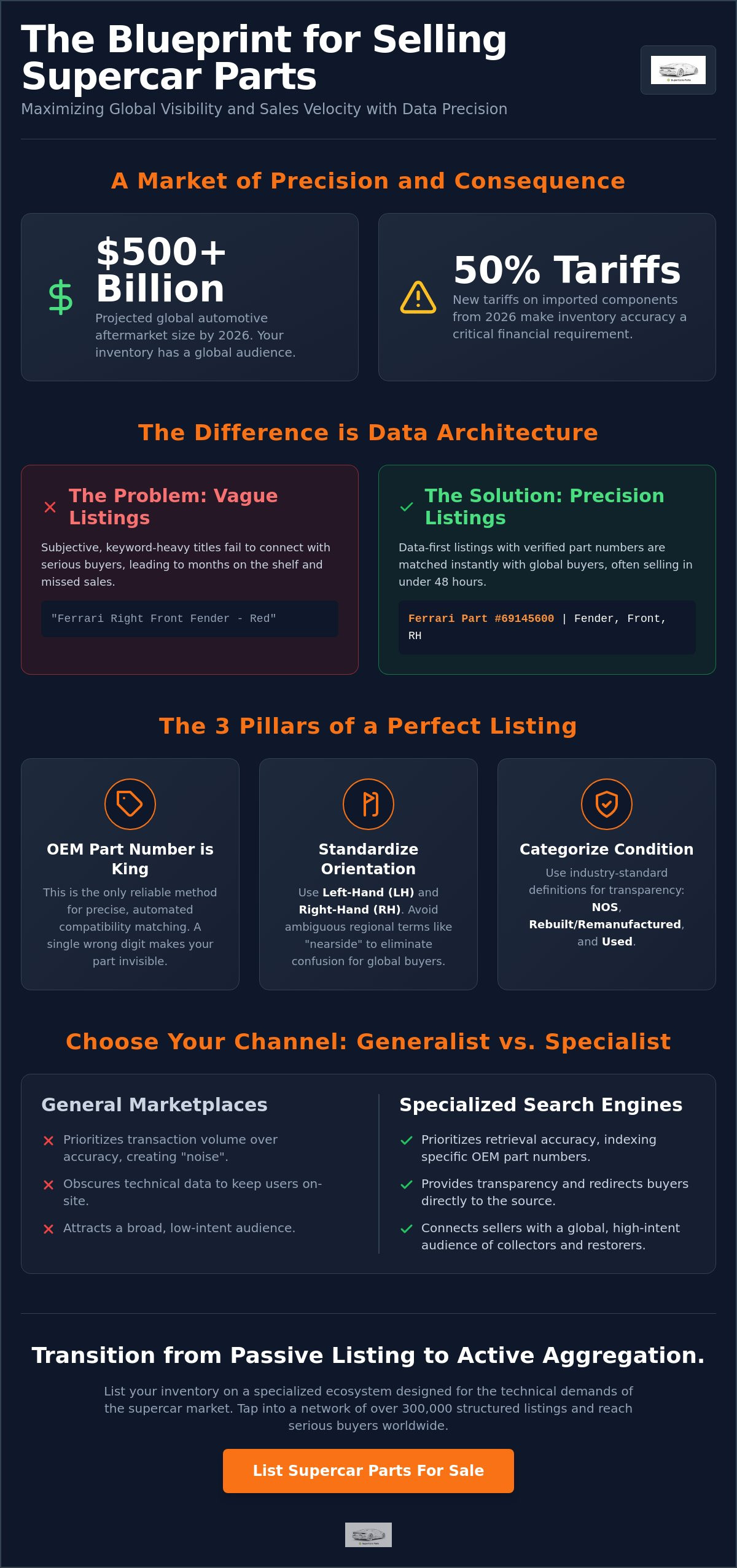
The global automotive aftermarket is projected to exceed $500 billion in 2026, yet many sellers struggle with fragmented data standards across different brands. With new 50% tariffs on imported steel and aluminum components effective as of April 6, 2026, inventory accuracy isn't just a preference; it's a financial requirement. This guide provides a precise framework for structuring high-value exotic components to maximize global visibility and search accuracy. We'll examine the technical requirements for part-number matching, compatibility data standards, and the integration of your inventory with specialized search engines designed for the 2026 market.
Key Takeaways
- Prioritize OEM part number accuracy to eliminate search ambiguity and ensure precise compatibility matching for global buyers.
- Standardize component descriptions using Left-Hand (LH) and Right-Hand (RH) orientation markers to reduce returns and improve data integrity.
- Implement a data-first framework when you list supercar parts for sale to bypass the noise of general marketplaces and reach targeted collectors.
- Utilize specialized mobile inventory apps and programmatic API integrations to maintain real-time synchronization across global distribution networks.
- Transition from passive listing models to active search engine aggregation to maximize visibility within high-intent supercar procurement channels.
The Infrastructure of Modern Supercar Parts Distribution
The automotive aftermarket for exotic vehicles has transitioned from regional salvage yards to a decentralized, digital-first model. High-value inventory is no longer tied to local demand. It relies on global discoverability. Sellers who list supercar parts for sale must recognize that traditional keyword-heavy descriptions are insufficient. Modern distribution depends on structured data. This shift ensures that a rare Ferrari transaxle in London is visible to a restorer in Los Angeles within milliseconds. Precision replaces proximity. The infrastructure is now modular. It treats each component as a unique data point in a global network.
Data aggregation functions as a translation layer. It normalizes fragmented data from disparate sources into a unified format. This allows for seamless cross-referencing of part numbers across different model years and variants. Without this structure, rare inventory remains hidden in digital silos. Effective distribution requires more than just a listing; it requires integration into a specialized ecosystem. This ecosystem prioritizes technical accuracy over marketing hyperbole. It's a shift from physical storage to digital management where information density determines the speed of the sale.
Search Engines vs. Marketplaces: Key Differences
Traditional marketplaces prioritize transaction volume. They often obscure technical specifications to keep users within their ecosystem for SEO purposes. This creates noise. A specialized search engine operates differently. It prioritizes retrieval accuracy. It indexes specific OEM identifiers for brands like Lamborghini or McLaren. While a marketplace focuses on the sale, a search engine focuses on the match. It redirects users directly to the source. This transparency is vital for high-ticket components where provenance and technical compatibility are non-negotiable. Marketplaces are generalists; search engines are specialists.
The Global Reach of Digital Aggregators
Digital aggregators bridge the gap between fragmented inventories and a global audience. A single listing reaches enthusiasts across the United States and Europe simultaneously. This is achieved through centralized search interfaces that process over 300,000 structured listings. Geographical barriers are irrelevant when the data is centralized. When you list supercar parts for sale through a specialized aggregator, you tap into a high-intent user base. These platforms utilize sophisticated indexing to ensure that search results are filtered by precise mechanical criteria. This efficiency reduces the time-to-sale for boutique sellers handling rare components. Inventory discoverability is no longer a matter of luck. It's a matter of algorithmic alignment.
Technical Standards for Listing Supercar Parts for Sale
Technical integrity in the supercar segment requires adherence to rigorous data protocols. When you list supercar parts for sale, the primary identifier is the Original Equipment Manufacturer (OEM) part number. It's the only reliable method for ensuring cross-border compatibility. Adherence to SAE International technical standards ensures that mechanical components meet global quality and safety benchmarks. Subjective descriptions lead to returns. Technical data leads to conversions. High-value transactions depend on this objective foundation.
Standardization extends to orientation descriptors. Use Left-Hand (LH) and Right-Hand (RH) relative to the driver's seat. Avoid regional terms like "nearside" or "offside" which create ambiguity in international trade. Condition categorization must follow industry-standard definitions to maintain transparency:
- New Old Stock (NOS): Original parts, unused, often in original packaging.
- Rebuilt/Remanufactured: Components restored to OEM specifications by certified technicians.
- Used: Parts with documented mileage and functional history.
Part Number Precision and Verification
A single missing digit in a McLaren or Porsche part number renders the listing invisible to automated search crawlers. Accuracy is binary. Sellers must cross-reference part numbers with official technical diagrams to account for superseded numbers. A superseded number occurs when a manufacturer replaces an older part with a revised version. Listings that include both the current and legacy part numbers capture a wider search intent. High-resolution documentation of casting marks and stamped identifiers provides visual proof of authenticity. Casting marks on magnesium or aluminum alloy wheels, for example, verify load ratings and manufacturing dates. These details are critical for liability and fitment verification.
Descriptive Accuracy for Exotic Components
Precision in mechanical assemblies requires objective data. For high-value items like V12 engines or dual-clutch transmissions, specify the donor vehicle's chassis number and total mileage. Documentation of service history and compression test results adds necessary transparency. Avoid adjectives. Use measurements. For carbon fiber components, specify the exact weave, such as 1x1 plain or 2x2 twill. Mention if the UV-protective clear coat is factory-original. These specifics prevent mismatched aesthetics in high-end restorations. This level of granular detail allows a specialized supercar parts search engine to index the inventory with surgical precision. Integration with global search engines depends entirely on this data density. Accurate metadata reduces the signal-to-noise ratio in competitive marketplaces.
Comparing Distribution Channels for High-Value Inventory
Volume-based logic dictates general marketplace operations. These platforms prioritize broad accessibility over technical depth. For boutique sellers, this creates a significant signal-to-noise problem. Rare components are often buried under thousands of generic aftermarket accessories. This fragmentation dilutes the visibility of high-value items. Professional procurement specialists bypass consumer-grade platforms. They require precision. When you list supercar parts for sale, the choice of channel determines the quality of the lead. A specialized environment ensures that technical specifications remain the primary search driver.
Audience targeting is binary. General marketplaces reach casual hobbyists. Specialized search engines reach professional restorers and fleet managers. The latter group operates on technical requirements. They don't browse; they retrieve. This distinction is critical for inventory turnover. High-ticket items require a platform that understands the nuance of exotic car components. Data-driven placement reduces the time spent answering non-technical inquiries from unqualified buyers.
General Marketplaces: Volume vs. Value
Transaction-based platforms charge substantial fees for their infrastructure. As of June 2026, eBay Motors applies a final value fee of 13.25% on the first $7,500 of a sale. The portion exceeding $7,500 incurs a 2.35% fee. For high-ticket items like a $60,000 McLaren engine, these costs are significant. Beyond financial overhead, these platforms lack specialized metadata fields. The absence of structured data forces sellers to rely on descriptive titles. This reduces search accuracy. High-risk components require an environment that prioritizes technical data over consumer convenience.
Specialized Aggregators: The Professional Choice
Specialized search engines remove the friction of the transaction layer. They focus on retrieval. These platforms act as a high-performance bridge between sellers and high-intent buyers. By indexing over 300,000 exotic items, the SuperCars.Parts search engine provides a concentrated environment for professionals. This indexing allows for surgical part-number matching. When you list supercar parts for sale through an aggregator, your inventory enters a global database. This placement targets restorers who search by OEM part numbers rather than vague keywords.
Programmatic distribution is essential for large inventories. Utilizing the SuperCars API or a dedicated Parts Listing Service ensures real-time synchronization. This prevents ghost inventory. Programmatic models prioritize data integrity. They ensure every component is visible at the point of technical inquiry. This systematic approach to placement maximizes turnover by reaching a global, specialized audience without the noise of general retail channels. For global enterprises managing complex dealer networks, solutions from Computer Market Research help automate and optimize these distribution channels.
Optimization Strategies for Boutique Parts Sellers
Inventory digitization is a prerequisite for global distribution. Boutique shops must transition from static spreadsheets to dynamic, structured database entries. This shift eliminates data fragmentation. It ensures that every component is indexed correctly. When you list supercar parts for sale, the speed of entry determines market responsiveness. Real-time management prevents the sale of ghost inventory. It maintains the integrity of the global search ecosystem. In the 2026 market, where supply chain diversification is standard, accurate digital records are essential for navigating complex logistics and tariff regulations.
Maximizing visibility for rare "halo car" components requires high data density. Naturally aspirated V12 engines from the 2010-2020 era are now investment-grade assets. Their value depends on documented provenance and technical verification. Sellers must provide granular details to satisfy the requirements of high-intent search queries. This architectural approach to inventory ensures your rare components are visible to the most qualified global buyers.
Digital Inventory Management for Shops
Manual logging is inefficient. The SuperCars Inventory App facilitates rapid component documentation directly from the warehouse floor. It captures essential metadata: part numbers, condition, and orientation. This data syncs across multiple search platforms instantly. Structured entries allow for granular filtering. A shop specializing in Italian exotics can manage thousands of SKUs with surgical precision. This level of organization is necessary for high-turnover environments, and utilizing a dedicated business management tool like Számlázó Programom can help reduce administrative overhead by automating invoicing and CRM tasks. It maximizes technical accuracy. Real-time synchronization ensures that a part sold on one channel is immediately removed from the global search engine.
Structuring Data for Search Engine Retrieval
Search engine algorithms prioritize structured data over prose. Formatting descriptions for API compatibility is essential. Use brand-specific identifiers. Reference Sant’Agata for Lamborghini or Maranello for Ferrari components to align with expert search patterns. Technical queries are specific. A search for "Bentley 3W0819359" targets a precise HVAC component. Vague descriptions like "Bentley heater part" fail to trigger specialized indexing. Precision is the primary driver of retrieval.
Optimizing for "People Also Ask" (PAA) requires clear, data-driven answers within the listing. Include compatibility ranges, superseded part numbers, and emissions compliance data, such as CARB EO status for aftermarket performance parts. This captures long-tail search traffic from restorers and technicians. For professional assistance in digitizing your stock, utilize our Parts Listing Service to ensure your inventory meets global search standards. Precision in data structure bypasses the limitations of traditional keyword-based SEO.
Leveraging the SuperCars.Parts Listing Ecosystem
The SuperCars.Parts search engine functions as a centralized aggregator for over 300,000 exotic components. It eliminates the fragmentation inherent in traditional marketplaces. By consolidating inventory from boutique sellers, specialized salvage yards, and official distributors, the platform creates a high-density data environment. This ecosystem prioritizes technical retrieval over retail browsing. When you list supercar parts for sale through this ecosystem, you move inventory from passive storage to active search indexing. Every word in the database serves a retrieval purpose. It ensures that specialized inventory is visible to a global network of restorers, insurance adjusters, and fleet managers.
API Integration for Large-Scale Sellers
Programmatic inventory management is the standard for high-volume boutique shops. The SuperCars API facilitates a direct data stream between internal warehouse management systems and the global search engine. Unlike generic seller APIs, this interface is optimized for supercar-specific metadata. It automates updates for availability, pricing, and technical revisions. This automation prevents the listing of out-of-stock items. It ensures real-time accuracy across all search channels. API licensing also provides access to structured data streams for competitive market analysis. Sellers can monitor global demand for specific OEM part numbers to adjust procurement strategies. This data-driven approach allows for precise stock valuation based on global scarcity.
Getting Started with the Listing Service
Boutique sellers require a low-friction entry point for inventory placement. The Parts Listing Service provides a managed framework for boutique shops that need to list supercar parts for sale without manual entry errors. Submitting inventory involves providing structured CSV or XML feeds containing OEM part numbers, condition codes, and orientation markers. The platform doesn't handle transactions. It functions as a high-performance bridge. It redirects high-intent buyers directly to your storefront or contact interface. This model preserves the seller's brand identity and customer relationship while maximizing global reach. List your supercar parts for sale via our specialized search engine today.
The integration process focuses on data integrity. Each listing undergoes technical verification to ensure part number accuracy. This layer of curation maintains the engine's reputation for precision. It ensures that buyers find the exact component required for complex restorations. For shops aiming to scale their reach, joining this network provides an immediate competitive advantage. This systematic approach to distribution ensures that rare components reach the correct end-user without the delays of general consumer platforms. It's a functional tool for a technical market.
Strategic Alignment for Global Inventory Distribution
Technical accuracy remains the primary driver of turnover in the exotic car parts market. Prioritizing OEM part numbers and standardized orientation markers eliminates search ambiguity and reduces returns. This data-first approach ensures that rare components are visible to a targeted audience of professional restorers and enthusiasts. As global trade regulations and tariffs evolve, maintaining a precise digital inventory is a financial necessity. Every data point must serve the retrieval process.
When you list supercar parts for sale, the structural integrity of your metadata determines your visibility within specialized search engines. Our ecosystem currently indexes 300,000+ structured listings, providing a high-performance bridge between sellers and high-intent buyers. Accessing the SuperCars.Parts proprietary API allows for programmatic inventory distribution and real-time synchronization across global channels. This methodology replaces traditional marketing noise with surgical retrieval precision. Strategic placement within a specialized network maximizes discoverability for high-value items. It ensures your inventory meets the technical requirements of a sophisticated global market.
Access the SuperCars.Parts API and List Your Inventory to secure your position in the global supercar parts network. High-performance inventory management starts with architectural data clarity.
Frequently Asked Questions
How do I list supercar parts for sale on a specialized search engine?
Submit your inventory through the Parts Listing Service or integrate directly via the SuperCars API. Sellers provide structured data files, such as CSV or XML, containing precise technical identifiers. The search engine aggregates this information, indexing it by OEM part numbers to ensure immediate visibility to a global network of professional restorers and procurement specialists. This data-driven approach bypasses the noise of traditional consumer marketplaces.
What information is required to list an exotic car part accurately?
Accurate listings require the OEM part number, manufacturer brand, component condition, and orientation. Specify condition using industry-standard categories: New Old Stock (NOS), Rebuilt, or Used. Orientation must be defined as Left-Hand (LH) or Right-Hand (RH) relative to the driver's position. For high-value mechanical assemblies, include donor vehicle chassis numbers and documented mileage to verify provenance and technical compatibility.
Why should I use a search engine aggregator instead of a marketplace like eBay?
Search engine aggregators prioritize technical retrieval accuracy over transaction volume. This environment eliminates the high signal-to-noise ratio of general marketplaces where rare components are often buried under generic accessories. Aggregators target high-intent buyers who search by part numbers. This model also allows sellers to avoid the high final value fees associated with consumer-grade platforms while maintaining direct control over the customer relationship.
Can I list both OEM and aftermarket supercar parts?
Yes, the platform supports both original equipment and aftermarket performance components. Aftermarket listings must include precise fitment data and emissions compliance status, such as CARB EO numbers for California-legal parts. Clear categorization between OEM and aftermarket ensures that buyers can filter results according to their specific restoration or performance requirements, maintaining the integrity of the technical search results.
How does the SuperCars API help with inventory management?
The SuperCars API provides a programmatic bridge for real-time inventory synchronization. It automates the flow of data between your internal warehouse management system and the global search engine, updating availability and technical revisions instantly. This automation prevents the listing of sold inventory and eliminates manual entry errors. It's a critical tool for large-scale boutique sellers who require data integrity across multiple distribution channels.
Is there a specific format for part numbers when listing for sale?
Use the exact alphanumeric string designated by the manufacturer without spaces or non-standard characters. It's recommended to include both the current part number and any superseded legacy numbers. This formatting ensures that when you list supercar parts for sale, your inventory remains compatible with automated indexing crawlers. Precise formatting is the primary factor in triggering successful matches for technical search queries.
Do search engines handle the transaction for the parts I list?
No, the specialized search engine operates as a technical facilitator and data curator. It does not process transactions or handle logistics. The platform redirects high-intent users directly to your storefront or contact interface. This allows the boutique seller to manage the sale, verify buyer requirements, and coordinate specialized shipping while benefiting from the global reach of a centralized search ecosystem.
How can I increase the visibility of my rare supercar parts online?
Increase data density by providing granular mechanical identifiers and high-resolution documentation of casting marks. Utilizing the SuperCars API ensures your inventory is indexed within a specialized database of 300,000+ items. Visibility is a function of data structure rather than marketing prose. Aligning your inventory with the technical search patterns of professional restorers is the most effective method for reaching qualified global buyers.