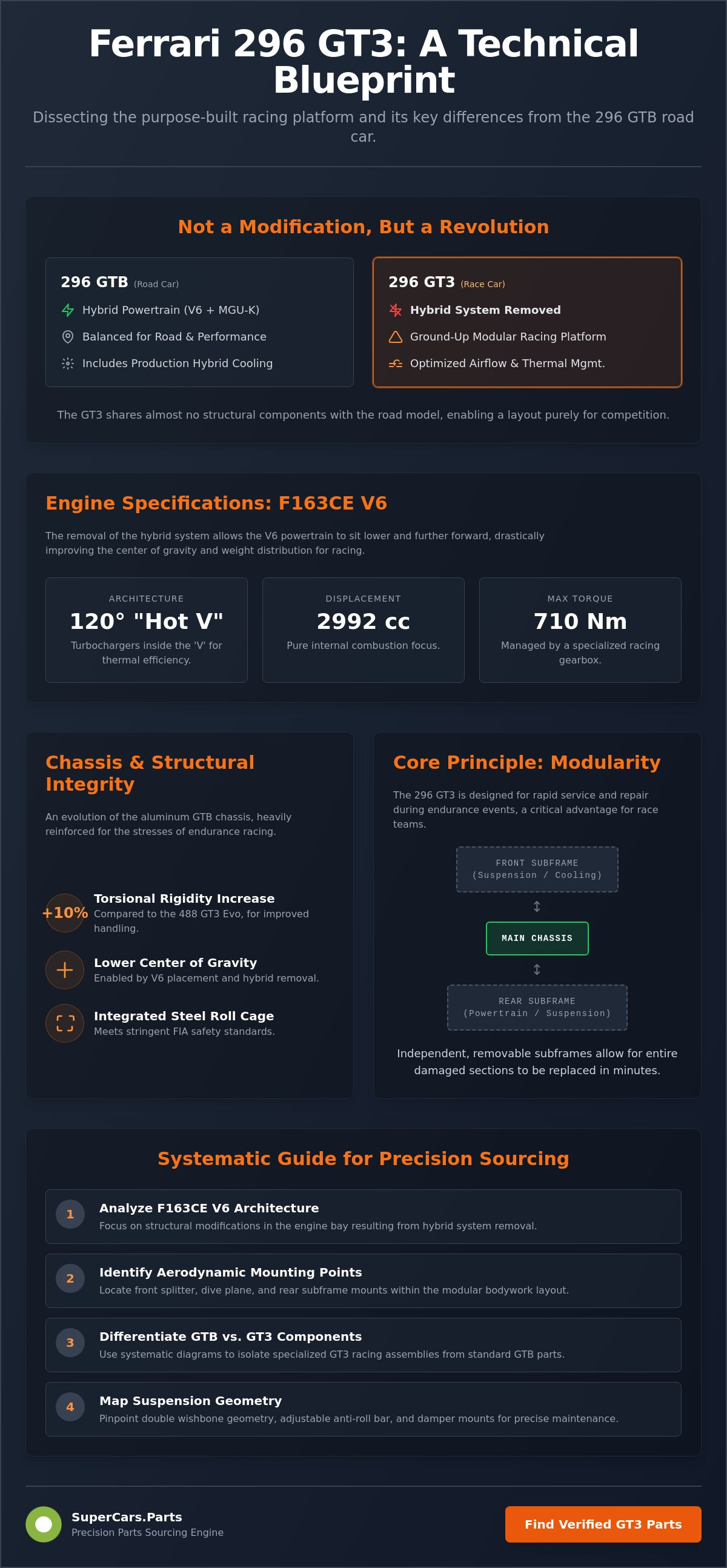
The Ferrari 296 GT3 is not a modified 296 GTB. It is a ground-up modular racing platform where almost no structural components cross over with the road-going production model. Technical specialists often face significant friction when trying to isolate GT3-specific part numbers within generic automotive databases. This technical reference provides a systematic gt3 ferrari 296 diagram to bridge the gap between complex global inventories and precise assembly identification. It eliminates the ambiguity inherent in sourcing high-performance components for the F163CE V6 engine and its associated competition subsystems.
You require a resource that prioritizes data-driven clarity over marketing descriptions. This guide delivers a structured breakdown of the 296 GT3 architecture, focusing on the 2026 Evo specifications and modular chassis subsystems. This categorization facilitates the rapid retrieval of specific part identifiers and component compatibility data. The following sections detail the F163CE V6 engine layout, aerodynamic cooling paths, and the specialized gearbox ratios required to manage the 710 Nm torque output. This information serves as a functional tool for professional teams managing global parts sourcing and assembly maintenance.
Key Takeaways
- Analyze the F163CE V6 120° architecture and the structural engine bay modifications necessitated by the removal of the production hybrid powertrain.
- Identify front splitter, dive plane, and rear subframe mounting points within the modular aerodynamic and bodywork layout.
- Utilize a systematic gt3 ferrari 296 diagram to differentiate between standard 296 GTB components and specialized GT3 racing assemblies.
- Map double wishbone suspension geometry and locate adjustable anti-roll bar and damper mounts for precise chassis maintenance.
- Streamline global inventory searches by cross-referencing diagram index numbers with verified OEM part identifiers to ensure component compatibility.
Technical Architecture of the Ferrari 296 GT3
The Ferrari 296 GT3 represents a definitive shift from the V8-powered 488 GT3 Evo to a high-performance V6 competition platform. While the road-going 296 GTB focuses on a balance between hybrid efficiency and performance, the GT3 variant is a specialized racing tool. The "Fun to Drive" engineering philosophy translates technically to a reduced polar moment of inertia and a lower center of gravity. A precise gt3 ferrari 296 diagram reveals that this racing model shares minimal structural DNA with its production counterpart. The removal of the hybrid battery and electric motors allows for a more compact, centered mechanical layout that adheres to 2026 FIA GT World Cup Sporting Regulations.
Chassis and Frame Evolution
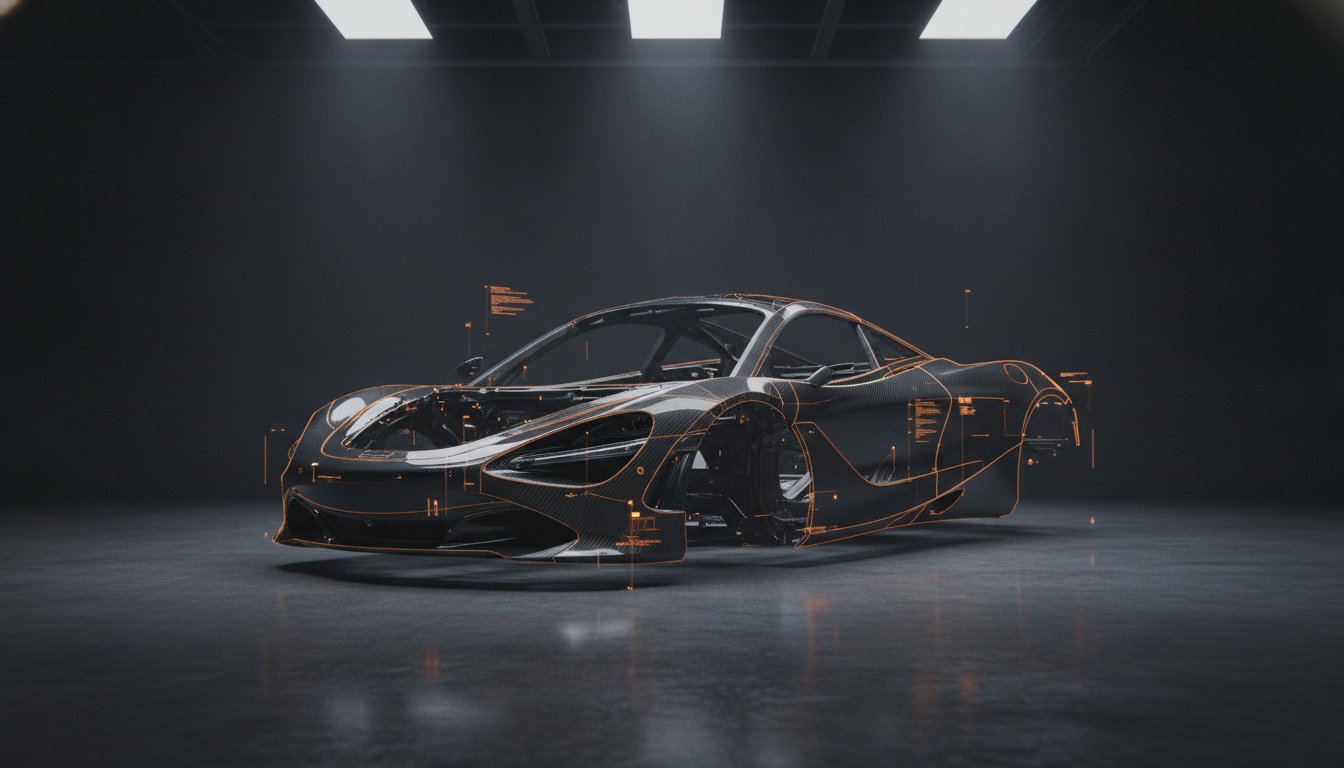
The 296 GT3 utilizes an aluminum chassis evolved from the 296 GTB, yet it features significant racing-specific reinforcements. Engineers integrated a high-strength steel roll cage directly into the primary structural diagram to meet stringent FIA safety standards. This integration increases torsional rigidity by approximately 10% compared to the 488 GT3 Evo. Weight distribution is optimized by the 120-degree V6 engine placement; the absence of hybrid components allows the powertrain to sit lower and further forward. This configuration ensures consistent tire contact patches and improved handling under high lateral loads. Technical schematics for the chassis identify specific mounting points for the pneumatic jack system and ballast containers required for Balance of Performance (BoP) compliance.
Modular Design Principles
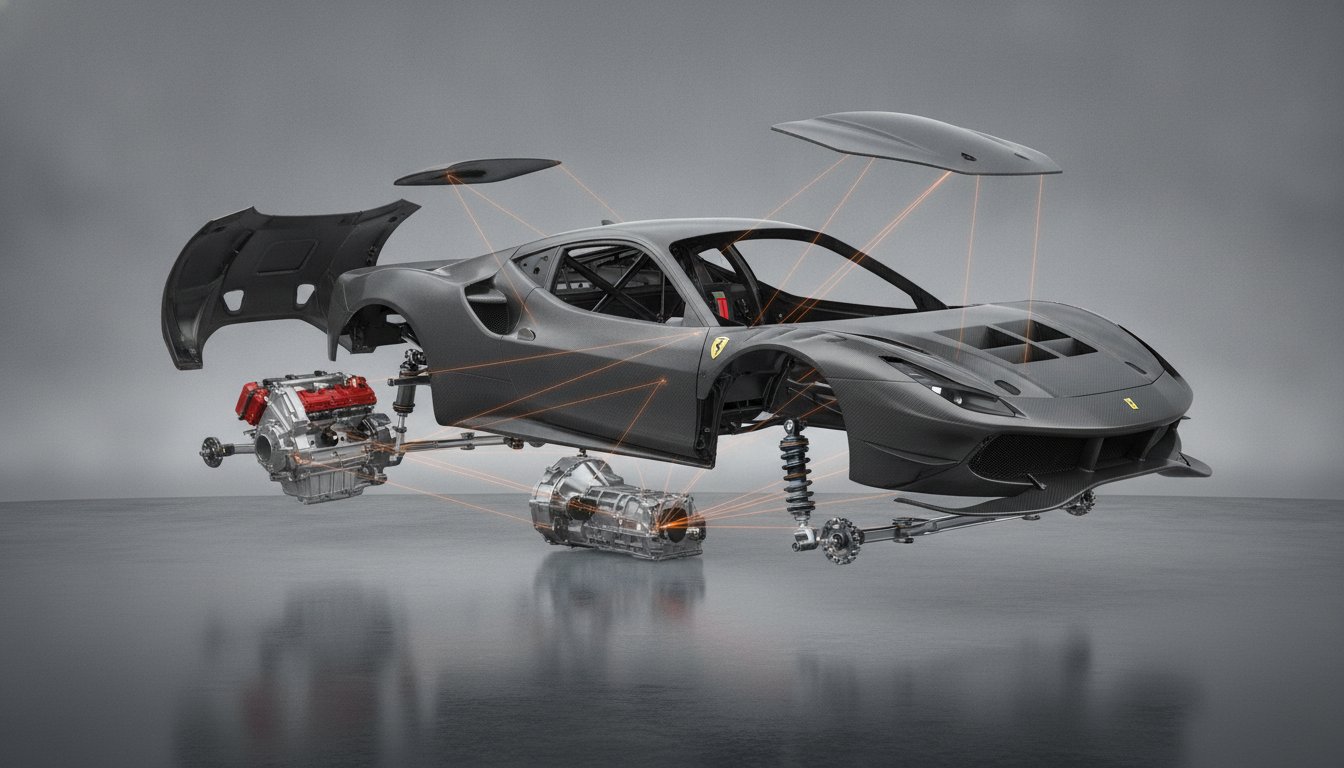
Modularity is the core architectural tenet of the 296 GT3 platform. The vehicle features independent, removable front and rear subframes that carry the entire suspension, cooling, and powertrain assemblies. These modules are secured to the main chassis via high-strength fasteners designed for rapid removal. This layout allows race teams to replace entire damaged sections in minutes during endurance events. Identifying these subframe-specific index numbers is a critical step when using an exotic car parts search engine. By utilizing a gt3 ferrari 296 diagram, technicians can isolate racing components from road-legal parts, ensuring the correct acquisition of GT3-specific sub-assemblies. The modular approach also simplifies the routing of electrical looms and fluid lines, which are mapped with surgical precision in the technical documentation to prevent interference during high-speed maintenance.
Technical schematics serve as the primary reference for maintaining race-spec performance standards. They define the exact tolerances for component alignment and the specific torque values for critical fasteners. Because the GT3 chassis lacks the production model's complex hybrid cooling loops, the engine bay layout is significantly more spacious. This space is repurposed for optimized airflow and thermal management, which is clearly visible in the top-down architectural diagrams of the vehicle. Every component location is a result of data-driven decisions aimed at maximizing aerodynamic efficiency and mechanical reliability.
Engine and Powertrain Assemblies: F163CE V6 Specifications
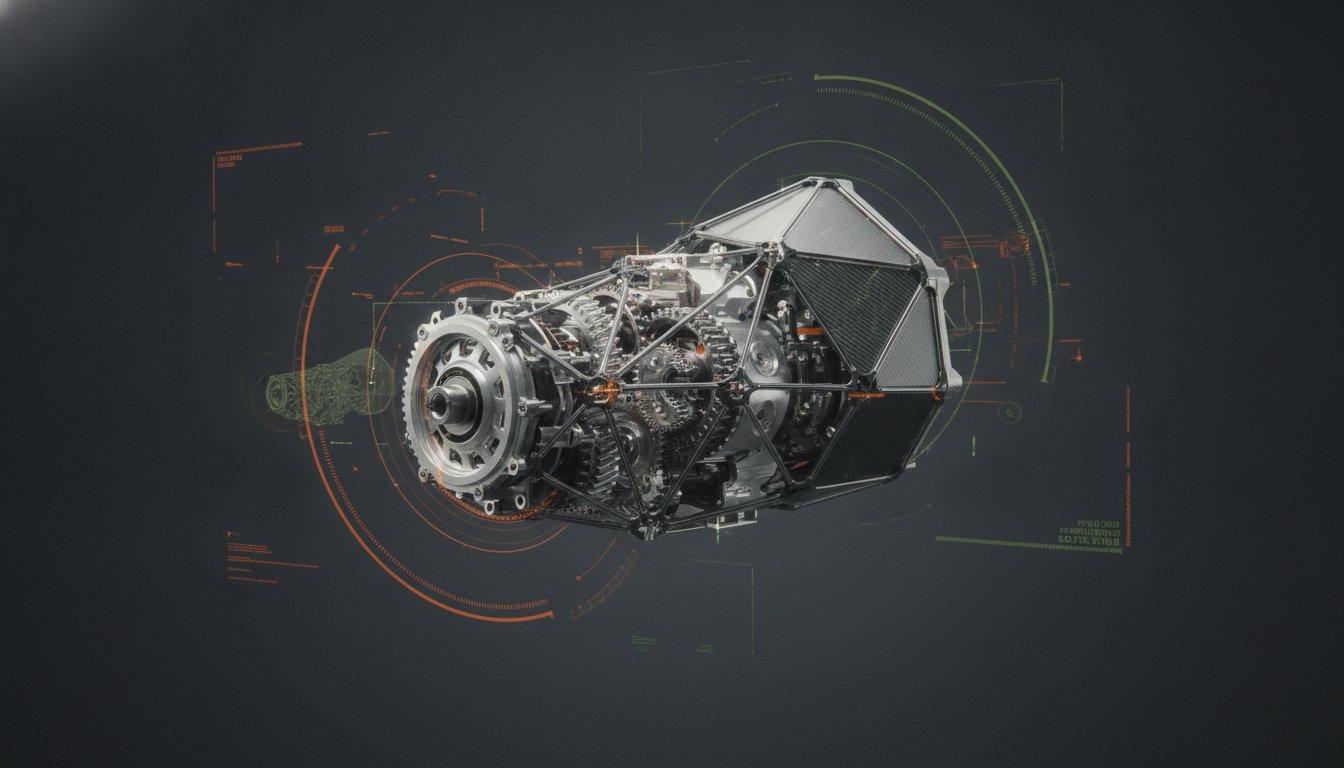
The F163CE power unit serves as the mechanical core of the 296 GT3. This 2992 cc V6 engine features a 120° bank angle, a configuration that permits the placement of turbochargers within the "V" of the cylinder banks. This "Hot V" architecture optimizes thermal efficiency and reduces the length of the intake and exhaust tracts. The Ferrari 296 GT3 technical specifications highlight the shift toward this configuration, where exhaust manifolds are routed internally to minimize heat soak to peripheral chassis components. A detailed gt3 ferrari 296 diagram illustrates the complete removal of the road-going hybrid system. By eliminating the MGU-K and high-voltage battery pack, engineers achieved a significant reduction in powertrain weight and simplified the engine bay layout for racing serviceability.
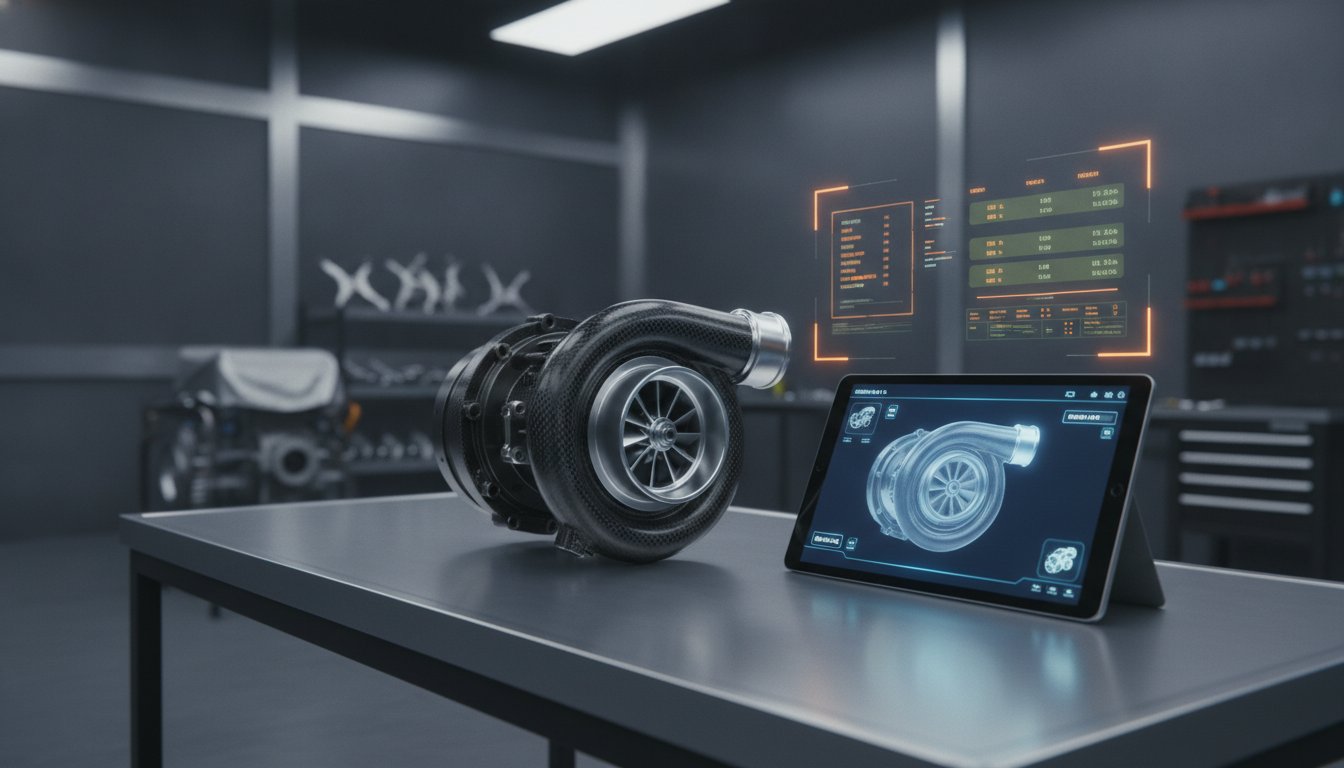
Thermal management is managed via specialized heat shielding and high-grade inconel exhaust manifold routing. These components are designed to withstand the sustained high-exit temperatures characteristic of GT3 endurance racing. The structural implications of the 120° layout also include a lower engine height, which directly contributes to the vehicle's reduced center of gravity. Technicians can verify specific drivetrain component IDs and heat shield part numbers using the SuperCars.Parts search engine to ensure compatibility with 2026 Evo upgrades.
Lubrication and Cooling Systems
The 296 GT3 utilizes a dry sump lubrication system to maintain consistent oil pressure under high lateral G-loads. The oil tank is positioned low within the engine assembly to maintain the target center of gravity. Cooling is provided by a network of radiators and heat exchangers located within the front aero-ducts. The gt3 ferrari 296 diagram for the cooling circuit shows specialized coolant line routing that bypasses the production model's hybrid cooling loops, focusing exclusively on the F163CE engine and the transversal gearbox. This streamlined system reduces the risk of leaks and simplifies trackside fluid management.
Transmission and Drivetrain
The drivetrain features a 6-speed transversal sequential gearbox, specifically developed for the GT3 platform. This transversal orientation improves weight distribution by concentrating mass within the wheelbase. Shift operations are managed by an E-clutch actuator mechanism, which is integrated with steering wheel paddle controls for rapid gear changes. The differential assembly is a dedicated racing unit, featuring adjustable ramp angles to fine-tune traction. Technical schematics identify the specific driveshaft dimensions and constant velocity (CV) joint specifications required to handle the regulated 710 Nm of torque. This gearbox assembly is a standalone racing component, sharing no internal parts with the 296 GTB's dual-clutch transmission.
Aerodynamic and Bodywork Diagrams: Modular Component Layout
The aerodynamic architecture of the 296 GT3 is a modular system engineered for maximum downforce and rapid trackside serviceability. A technical gt3 ferrari 296 diagram provides the necessary indexing for the carbon-fiber body panels, which are secured using a combination of high-strength fasteners and quick-release pins. This indexing allows technicians to identify and replace specific damaged components, such as dive planes or fender extensions, without compromising the vehicle's overall aerodynamic balance. Unlike the production 296 GTB, the GT3 variant utilizes a segmented underbody aero-tray. This design optimizes ground effect by managing airflow through dedicated venturi tunnels while allowing for the localized replacement of worn floor segments.
The rear diffuser and wing assembly are mounted directly to the rear subframe, ensuring that aerodynamic loads are transferred to the chassis rather than the bodywork. The diffuser is a single-piece carbon-fiber unit that manages high-velocity airflow from the underbody. Structural pylons for the rear wing feature multiple adjustment points for fine-tuning downforce levels based on track requirements and Balance of Performance (BoP) limits. Technicians can locate specific replacement panels and mounting hardware through the supercars parts search engine by utilizing the part numbers indexed in the technical schematics.
Front Aero Assembly
The front aerodynamic package is centered around an integrated S-Duct. This component directs high-pressure air from the central intake through an internal channel, exhausting it over the front hood to create a low-pressure zone beneath the car. A gt3 ferrari 296 diagram of the front clip identifies the routing for the brake cooling ducts. These ducts are independent of the engine cooling circuit, providing a dedicated air supply to the front calipers and discs. For endurance racing, the front assembly includes specialized mounting points for auxiliary lighting systems, which are pre-wired into the vehicle's electrical loom for rapid installation during 24-hour events.
Rear Aero and Cooling
The rear bodywork focuses on thermal extraction and high-speed stability. The engine cover features a series of louvers and venting apertures designed to evacuate heat from the "Hot V" turbocharger configuration. Rear fender flares are equipped with integrated wheel arch liners that reduce pressure build-up and manage wake turbulence. The rear wing utilizes a swan-neck pylon design, which improves airflow to the underside of the main plane. The pylon structure includes multiple adjustment holes, allowing for precise angle-of-attack changes during setup sessions. All rear bodywork components are mapped to specific index numbers to facilitate rapid identification and sourcing of GT3-specific racing parts.
Chassis and Suspension Geometry: GT3-Specific Components
The Ferrari 296 GT3 utilizes a dedicated double wishbone suspension architecture on both the front and rear axles. This configuration differs fundamentally from the production 296 GTB by prioritizing kinematic precision and wide-range adjustability. A comprehensive gt3 ferrari 296 diagram identifies the specific mounting points for the five-way adjustable dampers and the multi-position anti-roll bars. These components are mounted to the modular subframes discussed in previous sections; this ensures that suspension loads are isolated from the primary chassis structure. High-precision technical schematics are essential for identifying these racing-only components. The GT3 doesn't share part numbers with road-legal variants, so it's essential to use visual verification via diagram as a mandatory step in the sourcing process.
Suspension Linkage and Arms
Upper and lower control arms are constructed from high-tensile tubular steel. These components are oriented to provide optimal camber gain and roll center stability for the 2026 Evo model. Unlike the production model's rubber bushings, the GT3 uses spherical joints to eliminate mechanical compliance under high aerodynamic loads. The gt3 ferrari 296 diagram maps the exact placement of the steering rack and tie rod assemblies. This placement is critical for minimizing bump steer over varied track surfaces. Technicians should reference these schematics when replacing damaged linkage to ensure that replacement arms match the specific racing geometry. Every joint and fastener is indexed to prevent the installation of non-homologated hardware.
Braking and Hub Assemblies
The braking system is governed by the ABS Evo system, which is mapped within the vehicle's electronic and hydraulic diagrams. This system allows for fine-tuned intervention levels via steering wheel controls. Front and rear brake discs feature specialized cooling vane orientations to maximize heat dissipation during endurance stints. The master cylinders are located within a dedicated housing in the front compartment, connected to a pedal box with adjustable reach for driver ergonomics. Wheel hubs feature a central locking nut assembly designed to handle the 710 Nm of torque delivered by the F163CE engine. These nuts include an integrated safety locking mechanism to prevent loosening under high-frequency vibration. To identify specific rotor part numbers or caliper seal kits, use the supercars parts search engine for precise component retrieval.
Systematic Parts Retrieval: Utilizing Diagrams for Sourcing
Precision sourcing for the Ferrari 296 GT3 depends on the accurate translation of visual data into procurement strings. A gt3 ferrari 296 diagram acts as the primary interface between mechanical assembly and inventory acquisition. Technicians must cross-reference diagram index numbers with original equipment manufacturer (OEM) part numbers to ensure zero-error assembly. Distinguishing between standard 296 GTB components and GT3-specific racing parts is mandatory; road-legal parts lack the homologated tolerances and structural reinforcements required for FIA GT World Cup compliance. Using technical schematics allows for the identification of parts that appear identical but possess different metallurgy or weight specifications, such as the titanium fasteners used in the GT3 suspension versus the steel variants in the production model.
Identifying OEM Part Numbers
Technical parts catalogs for Ferrari are organized into TAV (Tavole) sections. Each TAV provides an exploded view of a specific subsystem, from the F163CE cylinder head to the transversal gearbox housing. The TAV indexing system for Ferrari parts utilizes a hierarchical numbering structure that links visual diagram callouts directly to specific alphanumeric OEM codes. Locating unique identifiers for 296 GT3 engine components requires access to the latest 2026 Evo technical bulletins. These bulletins contain the revised part numbers for the upgraded aerodynamic splitters and cooling exchangers introduced for the current racing season. Failure to use the correct index results in the acquisition of obsolete pre-Evo components that may not meet current homologation requirements.
Global Sourcing via Aggregators
Locating rare assemblies, such as the E-clutch actuator or carbon-fiber subframe segments, requires a broader search than traditional dealer networks. The SuperCars.Parts search engine facilitates this by aggregating global inventory data into a single, searchable interface. This tool allows users to input OEM identifiers retrieved from a gt3 ferrari 296 diagram to compare availability across international suppliers. This capability is essential for sourcing high-value racing components that are often produced in limited batches or held in specialized racing inventories.
Data accuracy in these searches relies on precise orientation descriptors. Technical diagrams specify components as "Left" or "Right" based on the vehicle's longitudinal axis; misidentifying these orientations leads to significant logistical delays. For professional teams managing multiple chassis, the SuperCars API provides programmatic inventory tracking. This allows for automated monitoring of critical spares, ensuring that high-wear items like brake rotors and suspension joints are replenished before stock depletion. Verifying part compatibility through technical schematics prior to purchase remains the final safeguard against incorrect component acquisition. This systematic approach ensures that every replacement part meets the rigorous performance standards of the 296 GT3 racing platform.
Optimizing Ferrari 296 GT3 Component Procurement
The Ferrari 296 GT3 architecture prioritizes modularity and rapid serviceability through its independent subframe design and F163CE V6 layout. Utilizing a precise gt3 ferrari 296 diagram is the only method to ensure that racing-specific components are correctly identified and distinguished from road-going 296 GTB parts. This technical clarity prevents procurement errors and maintains the vehicle's homologated performance standards during high-stakes competition. Efficient maintenance cycles rely on the ability to bridge the gap between technical schematics and physical inventory.
Accessing a centralized resource for rare racing assemblies reduces downtime and simplifies the logistical complexities of global sourcing. Our search engine provides precision data for Ferrari, Lamborghini, and McLaren, aggregating global inventory to facilitate the retrieval of specialized components. Search the Global Inventory for Ferrari 296 GT3 Parts to access over 300,000 supercar part listings and secure rare racing components with surgical precision. Streamlining your parts acquisition process ensures your platform remains competitive and compliant with 2026 racing regulations.
Beyond the technical demands of the track, the culture surrounding high-performance automotive engineering often intersects with an appreciation for timeless style and iconic memorabilia. For enthusiasts who value this connection, Galerie Prints offers a curated selection of fine art photography and cinema memorabilia that captures the essence of classic elegance.
Frequently Asked Questions
Where can I find the official Ferrari 296 GT3 technical manual?
Official Ferrari 296 GT3 technical manuals are accessible primarily through the Ferrari Modis portal or authorized racing departments such as Competizioni GT. These documents are restricted to licensed racing teams and authorized service centers. Independent operators often locate specific assembly data and component identifiers through specialized parts aggregators and search engines.
How do the 296 GT3 diagrams differ from the 296 GTB road car?
A gt3 ferrari 296 diagram differs from road car schematics by highlighting a modular subframe architecture and the total absence of hybrid powertrain assemblies. The diagrams also illustrate a transversal gearbox orientation and racing-specific aerodynamic mounting points. These structural variations reflect the car's 2026 FIA GT World Cup homologation requirements and its focus on rapid trackside serviceability.
Are GT3 engine components compatible with standard 296 models?
Engine component compatibility between the GT3 and road models is extremely limited. While both use the 3.0-liter V6 architecture, the GT3 variants feature specialized turbos, inconel manifolds, and dry sump lubrication systems. These racing parts aren't interchangeable with standard 296 GTB components due to differing mounting tolerances, structural mounting points, and cooling requirements.
What is the displacement and engine type shown in the 296 GT3 diagram?
The gt3 ferrari 296 diagram specifies a 2992 cc displacement for the F163CE engine. This is a 120-degree V6 power unit utilizing a twin-turbocharged configuration. This specific architecture is designed to maximize thermal efficiency and lower the vehicle's polar moment of inertia, allowing the engine to sit lower within the chassis compared to traditional V6 layouts.
Can I source individual 296 GT3 body panels using these diagrams?
Individual 296 GT3 body panels are identifiable and sourceable using the TAV (Tavole) indexing system. Each carbon-fiber segment, from the front splitter to the rear diffuser, is assigned a unique racing-specific part number. These identifiers are essential for retrieving the correct components via a parts search engine and ensuring compatibility with the 2026 Evo bodywork updates.
How do I identify the correct sequential gearbox parts for a Ferrari 296 GT3?
Correct identification of sequential gearbox parts requires referencing the dedicated transversal transmission TAVs. The GT3 uses a 6-speed sequential unit, which shares no internal components with the production 8-speed dual-clutch gearbox. Technicians must verify part numbers against the specific technical updates to ensure compatibility with the E-clutch actuator and steering wheel paddle integration.
Is the Ferrari 296 GT3 engine twin-turbocharged?
Yes, the Ferrari 296 GT3 engine utilizes a twin-turbocharged configuration. The turbos are positioned within the "Hot V" of the 120-degree cylinder banks to reduce intake path length and improve throttle response. This layout is a standard feature in the F163CE technical architecture and is clearly mapped in the engine bay's thermal management schematics.
What is the significance of the 120-degree V6 angle in the 296 GT3 schematics?
The 120-degree V6 angle is significant for its impact on center of gravity and engine packaging. This wide angle allows the engine to sit lower in the chassis and provides the necessary volume for turbocharger integration between the cylinder heads. It's a primary differentiator in the GT3's mechanical schematics, contributing to the "Fun to Drive" engineering philosophy.